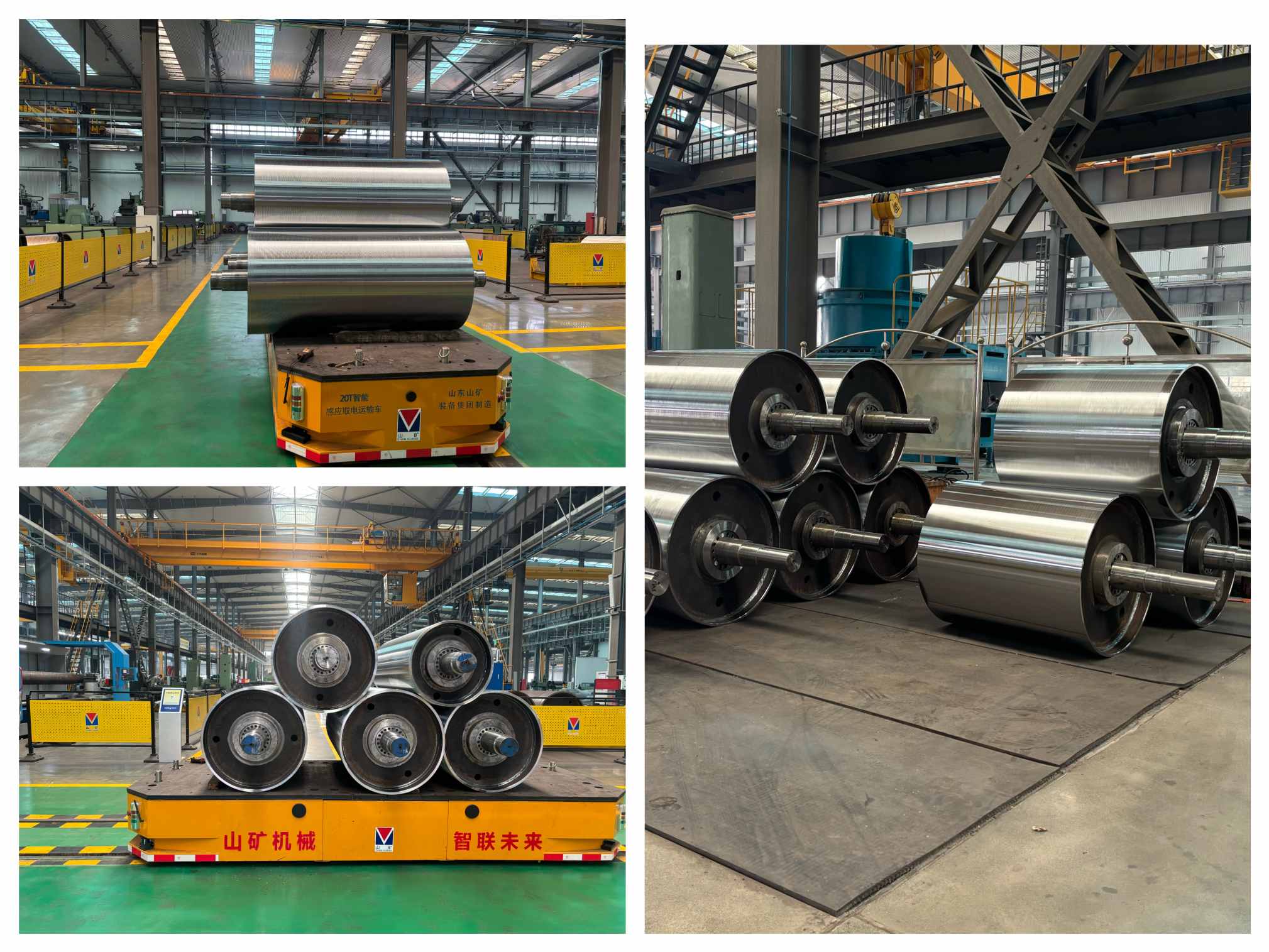
Pulleys are being produced in the workshop of Shandong Shankuang today.
2026/03/21 14:47
The workshop operates in good order, and the manufacturing of conveyor pulleys is proceeding steadily and meticulously. As the core transmission components of conveying equipment, their production process consists of closely linked procedures. Every step is carried out solidly under the strict control of the staff, reflecting a pragmatic and meticulous production style.
Manufacturing starts with raw material pre-treatment. The staff selects high-quality steel with excellent strength and toughness, and conducts manual screening to remove impurities and rust attached to the surface. The steel is then sent to special equipment for straightening, with repeated adjustments to ensure a straight axis and avoid deviations in subsequent processing. After straightening, the steel surface is polished section by section to remove oxide layers and burrs, resulting in a smooth and flat surface that lays a solid foundation for subsequent forming.
Once raw material preparation is completed, the process enters pipe body forming. In accordance with technical requirements, skilled workers roll the steel and fix it with special tooling to ensure uniform roundness of the pipe body. After rolling, the joints are accurately aligned before welding. To prevent deformation caused by local overheating, sectional welding is adopted. Welding slag is removed promptly after each section, and the welds are inspected for uniformity and fullness. Any defects are repaired immediately to guarantee a robust pipe structure.
After welding and forming, the production moves to shaft head assembly. The staff first cleans the joint surfaces of the shaft heads and the pipe body to remove residual welding slag and oil, then applies special adhesive evenly. The shaft heads are accurately fitted into both ends of the pipe body and compacted with tooling. After the adhesive is initially cured, bearings and seals are installed. Lubricating grease is applied to the bearings before installation to ensure smooth rotation. Seals are carefully fitted to the gaps between the shaft heads and the pipe body and firmly compacted, effectively blocking dust and moisture to extend service life.
Upon completion of assembly, the pulleys enter the surface treatment stage. The whole pulley is subjected to derusting and degreasing first, with impurities removed by high-pressure spraying, followed by phosphating treatment to enhance coating adhesion. A wear-resistant and anti-corrosion coating is then applied evenly via spraying. The spraying angle is adjusted continuously to ensure full coverage and uniform thickness. After the coating cures naturally, manual inspection of surface smoothness is carried out, and excess particles are polished with fine sandpaper for a neat appearance.
The final inspection procedure is carried out with strict standards. Quality inspectors first conduct a full appearance inspection to confirm defect-free welds, intact coating and no surface damage. They then rotate the pulley with special tools to check for smooth rotation, free of jamming or abnormal noise. Meanwhile, the fastening strength between shaft heads and pipe body is verified to meet assembly standards. Only when all indicators are qualified can the pulley complete the current manufacturing process and proceed to subsequent procedures.