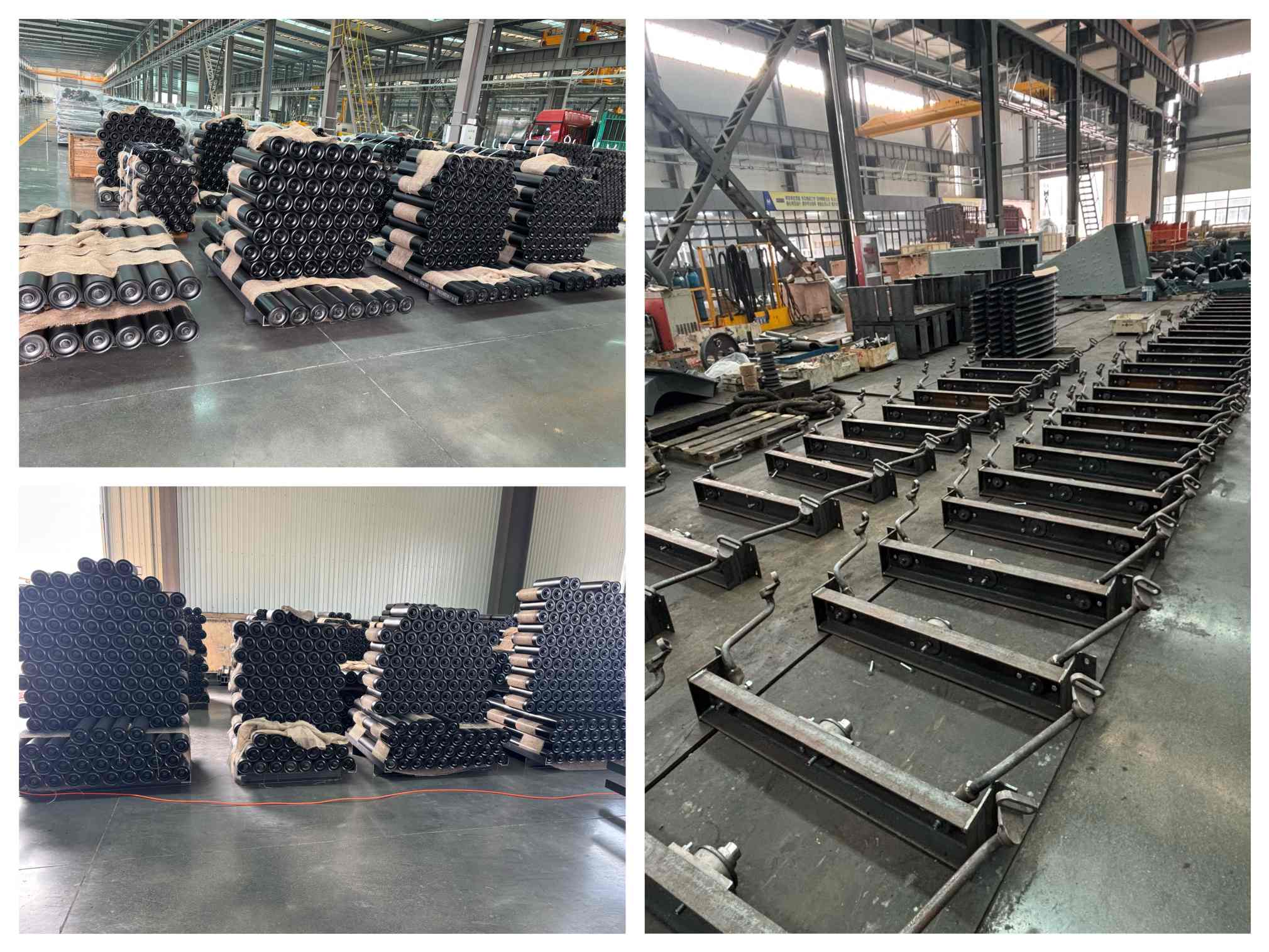
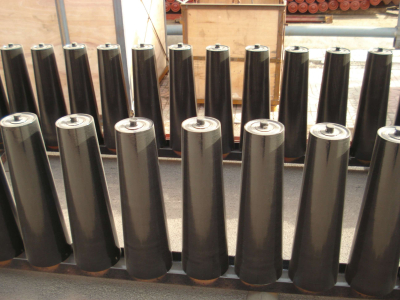
Rollers and roller frames are being produced in the workshop of Shandong Shankuang today.
The production of conveyor rollers and roller frames is underway simultaneously, with smooth and orderly connection between all processes. As core supporting components of the belt conveyor system, the precision and compatibility of these two parts directly determine the stable operation of the equipment. Every procedure in the workshop is carried out solidly under the careful control of the staff.
Strict control is applied to every technological detail in the roller production process. After raw materials arrive at the factory, they are manually screened to remove impurities first. Then professional equipment is used to conduct derusting and degreasing treatment on the pipe body, so as to ensure no residual oxide layer on the surface. Straightening of the pipe body is carried out next. Staff adjust equipment parameters repeatedly to ensure uniform roundness and straight axis of the pipe body, so as to avoid assembly deviation in the subsequent process. Before assembling the shaft heads and bearings, the surfaces of all parts must be wiped and cleaned one by one, and special lubricating grease shall be applied evenly. Then the bearings are accurately embedded into the clamping grooves of the shaft heads and pressed gently until fully fitted.
After assembly, the shaft head components are steadily installed into both ends of the pipe body. When installing the seals, it is necessary to ensure that the sealing lips fit closely with the inner wall of the pipe body, and then compact them with pressing tools to effectively block the intrusion of dust and moisture. Finally, surface spraying is carried out. Phosphating treatment is performed first to enhance coating adhesion, followed by uniform application of wear-resistant and anti-corrosion coating. After the coating is cured naturally, the surface smoothness is inspected manually, and the roller is rotated by hand to ensure smooth and jamming-free rotation.
Equal attention is paid to process details in the production of roller frames. After cutting with suitable steel plates, the plates are leveled to eliminate the stress generated during rolling. Then bending is carried out according to the designed shape. During bending, the angle is calibrated with a straightedge in real time to ensure a regular structure of the frames. Manual arc welding is adopted in the welding process. Skilled workers conduct welding in sections, and remove welding slag in time after each section to avoid defects such as slag inclusion and air holes. After welding, an angle grinder is used to smooth the welding seams, so that the surface of the frames is smooth without protrusions.
Next comes the drilling process. Hole positions are located with a template first, and then drilled accurately with a drilling machine. After tapping, iron chips in the holes are cleaned to ensure clear threads and smooth installation. Finally, the frames are subjected to overall derusting treatment, coated with anti-rust primer and topcoat. After the coatings are dried, the dimensional accuracy of the frames is inspected, and pre-assembly tests with rollers are carried out to ensure accurate connection and good compatibility.
During the whole production process, technicians conduct regular inspections on each procedure, and quality inspectors carry out sampling tests on key links. For rollers, key inspections focus on rotation flexibility and sealing performance; for frames, welding strength and hole position accuracy are verified. Staff strictly follow operating procedures, perform meticulous manual operations and precise machining, guaranteeing the quality of each product with solid craftsmanship, and providing reliable support for subsequent belt conveyor assembly.