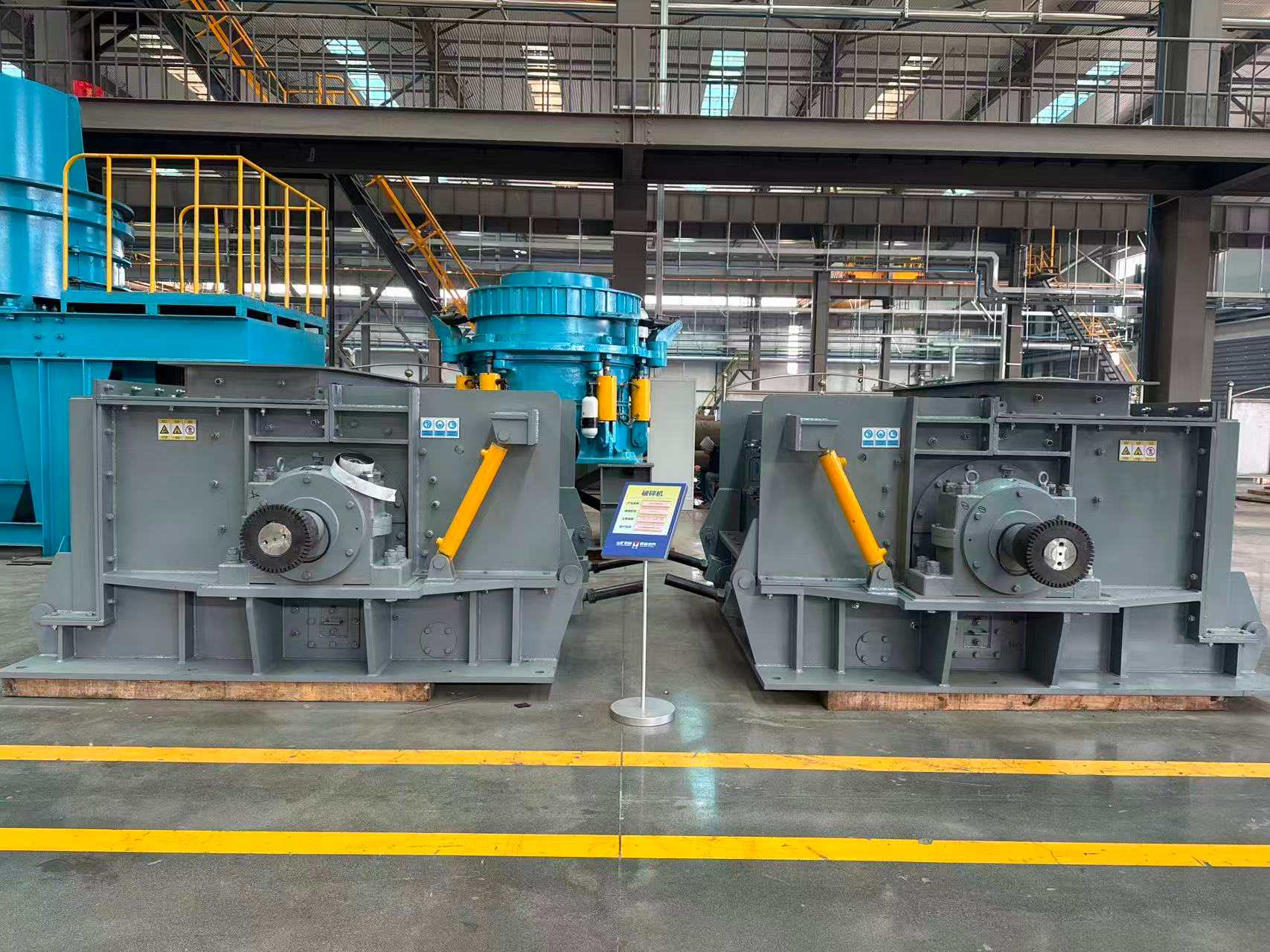
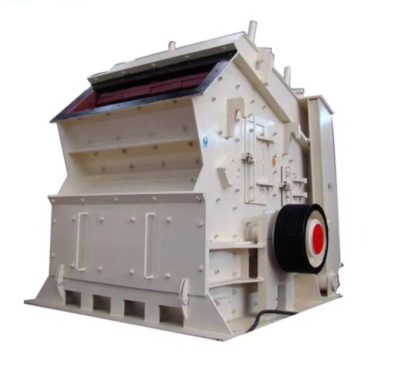
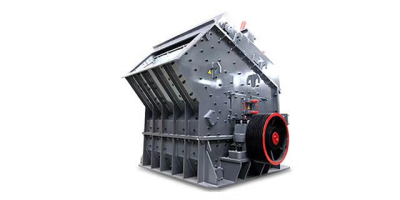
HSZ1016 Ring Hammer Crusher of Shandong Shankuang Machinery Co.,Ltd tests run.
The HSZ1016 ring hammer crusher is suitable for crushing various brittle materials with a particle size not exceeding 300 mm, such as coal, gangue, coke, slag, shale, loose limestone, etc. The compressive strength of the materials to be crushed shall not exceed 12 Mpa, and the surface moisture content shall not be greater than 9%. This crusher features a large crushing ratio, high production capacity, and uniform product particle size, and is widely used in industrial sectors such as metallurgy, building materials, chemical engineering, and hydropower.
This crusher is mainly composed of a rotor, a machine body, an adjusting mechanism and other key components. The motor directly drives the rotor via a coil spring coupling.
The rotor is mainly made up of a main shaft, end discs, hammer chucks, hammer shafts and ring hammers. The ring hammers are suspended on the hammer shafts, which are mounted on the end discs and hammer chucks. The end discs and chucks are fixed to the main shaft with flat keys and nuts.
The machine body consists of upper and lower casings, breaker plates, screen plates, screen frames and liner plates. The breaker plates and screen plates are installed on the screen frames. One end of each screen frame is suspended on the shaft seats on both sides of the casing through a shaft, and the other end is connected to the adjusting mechanism. The liner plates are attached to the inner walls of the casing to protect it from wear and tear. The breaker plates, screen plates and rotor form the crushing chamber. The adjusting mechanism is used to regulate the gap between the rotor and the screen plates.
The ring hammer crusher is an impact rotor crusher equipped with ring hammers. The ring hammers can not only revolve with the rotor but also rotate on their own axes around the hammer shafts. After materials enter the crushing chamber, they are first crushed by the impact of the ring hammers rotating at high speed along with the rotor. Meanwhile, the crushed materials gain kinetic energy from the ring hammers and rush toward the breaker plates at high speed, where they undergo secondary crushing. Then the materials fall onto the screen plates, are further crushed by the extrusion and abrasion of the ring hammers, and are discharged through the screen openings. Uncrushable materials and impurities enter the iron collection chamber and are removed regularly.
The control of discharge particle size is achieved by adjusting the linear speed of the rotor and the gap between the toothed ring hammers and the screen plates via the adjusting device.